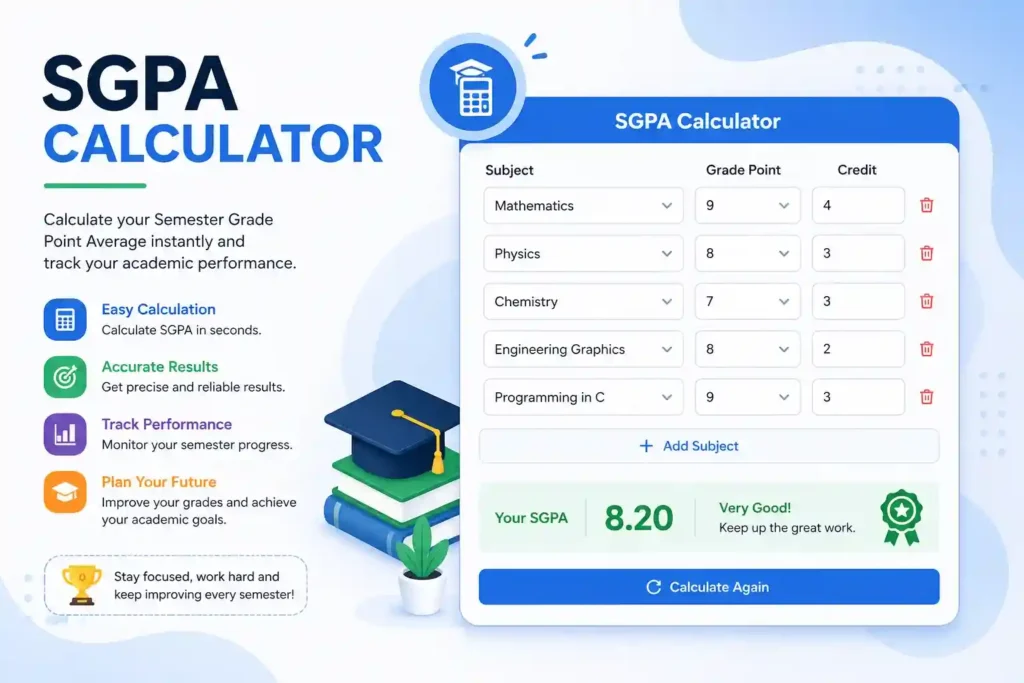
VTU SGPA Calculator – Calculate SGPA Easily

Free VTU SGPA Calculator for Students Calculate your SGPA using VTU grading system. Enter your grades and credits to get accurate results instantly.
VTU SGPA Calculator
VTU SGPA Calculator – Stop Guessing Your SGPA, Calculate It the Right Way
Most students don’t really think about SGPA… until suddenly it becomes important.
- Results are about to come out.
- Placement eligibility is getting closer.
- Or someone casually asks, “What’s your SGPA?”
And that’s when the confusion begins.
You try calculating it manually.
You open your notes.
You check formulas again and again.
…but something still doesn’t feel right.
If this sounds familiar, you’re definitely not alone.
The truth is, SGPA calculation in VTU is simple in theory—but confusing when you actually sit down to do it.
That’s exactly why using a VTU SGPA calculator makes life easier. It saves time, avoids mistakes, and gives you instant clarity.
This guide isn’t just about formulas and tools—it helps you truly understand SGPA, how it affects your future, and how you can improve it.
Instantly Calculate Your SGPA (Without Mistakes)
Let’s keep this simple.
Instead of spending time on manual calculations, you can use the VTU SGPA calculator above to get it done in seconds.
Here’s all you need to do:
- Enter your subjects
- Add grade points and credits
That’s it.
Within a few seconds, you’ll see your SGPA—clear and accurate.
No confusion. No double-checking formulas. No unnecessary stress.
What SGPA Actually Means in VTU
Most students memorise the term—but don’t truly understand it.
SGPA (Semester Grade Point Average) represents your performance in a single semester.
But here’s what makes it important:
It’s not just your marks—it’s your weighted performance.
VTU considers:
- Credits of each subject
- Grade points
- Overall balance
In simple words:
SGPA shows how well you performed in one semester, not your entire degree.
Why SGPA Matters More Than You Think
Many students ignore SGPA in the early semesters.
Later on—when placements, higher studies, or cutoffs come into the picture—you realise how much it actually matters.
Here’s what your SGPA really affects:
- Your CGPA (your overall academic score)
- Your eligibility for placements
- Applications for higher studies
- Your academic consistency over time
Even one low SGPA can pull down your overall CGPA more than you expect.
How VTU Calculates SGPA (Made Simple)
Let’s break this down in a simple way—no confusion, no complicated terms.
Don’t worry, this looks complicated at first. But it’s actually quite simple once you understand it.
The Formula
SGPA = Σ (Grade Point × Credit) ÷ Σ Credits
Simple Example
Let’s take a realistic situation:
- Subject 1 → Grade 9 × Credit 4 = 36
- Subject 2 → Grade 8 × Credit 3 = 24
- Subject 3 → Grade 7 × Credit 3 = 21
Total Grade Points = 81
Total Credits = 10
SGPA = 81 ÷ 10 = 8.1
This is exactly what the VTU SGPA calculator does automatically—without mistakes.
VTU Grading System (Understand This Once)
You don’t need to memorise everything. Just get the basic idea, and it will start making sense.
In VTU, your marks are converted into grade points, and these are what actually matter when calculating your SGPA.
Here’s how it works:
- O (Outstanding) → 10
- A+ → 9
- A → 8
- B+ → 7
- B → 6
- C → 5
- F → Fail
Think of it like this:
It’s not about your exact marks—it’s about the grade point you fall into.
These grade points are used in the VTU SGPA calculator to compute your result.
Quick tip:
Even a one-grade difference can slightly impact your final SGPA, so every subject counts.
What is a Good SGPA in VTU?
Almost every student reaches a point where they ask—
“Is my SGPA good enough?”
Let’s clear that doubt once and for all.
SGPA Range Guide
- 9.0+ → Excellent Performance (You’re performing at the top level)
- 8.0 – 9.0 → Strong Range (Very good for placements and academics)
- 7.0 – 8.0 → Decent (You’re doing okay—but improvement helps)
- Below 6.0 → Needs Attention (You need to focus—but it’s fixable)
Reality Check:
Your SGPA today is just a snapshot—not your full story. You still have time to improve and move forward.
One semester doesn’t define you—but repeated low SGPA can hurt your CGPA.
Common SGPA Mistakes Students Make
Let’s talk about real mistakes—not theory.
Here are some of the most common ones students make:
- Ignoring credit weight (this is the biggest one!)
- Using the wrong grade points
- Making small calculation errors
- Rushing through manual calculations
These mistakes may seem small—but they affect your SGPA badly.
That’s why many students prefer using a VTU SGPA calculator instead.
SGPA vs CGPA (Clear the Confusion)
This is where most students get confused—and honestly, it’s completely normal.
Let’s make it super simple:
SGPA (Semester Grade Point Average)
This is your performance in one semester only
CGPA (Cumulative Grade Point Average)
This is your overall performance across all semesters
Think of it like this:
- SGPA = One match
- CGPA = Full tournament
How to Improve Your SGPA (Practical Strategy)
Improving your SGPA isn’t about studying harder—it’s about making smarter choices in the right places.
Here’s what actually works in VTU:
- Focus on High-Credit Subjects (They affect your SGPA more)
- Don’t Ignore Internals (Assignments and attendance matter more than you think)
- Prepare Early (Last-minute study rarely gives stable results)
- Fix Weak Subjects (One bad subject can drop your SGPA)
Start small, stay consistent, and you’ll be surprised how much your SGPA can improve over time.
How SGPA Affects Your Future
You might not feel it right now—but your SGPA quietly shapes your future, one semester at a time.
It helps in:
- Building a strong CGPA over time
- Getting shortlisted for placements
- Applying for higher studies (India & abroad)
Think of your SGPA as a building block. Every semester adds something to your academic profile.
Even one low SGPA can pull your overall score down, but consistent improvement can lift it back up.
Can VTU SGPA Be Converted to a Percentage?
Yes, you can convert SGPA into a percentage.
Formula (approx):
Percentage = (SGPA – 0.75) × 10
Example:
- SGPA = 8
- Percentage = 72.5%
This gives you a quick estimate—but always double-check with your college or official VTU guidelines when it really matters.
When Should You Calculate SGPA?
Most students don’t think about their SGPA… until it suddenly becomes important.
But by then, it’s often a little late to plan properly.
You should check your SGPA:
- Right after your semester exams
- When results are expected
- Before placement season starts
- While tracking your improvement over time
Think of it this way:
SGPA isn’t just a result—it’s a signal.
The earlier you know where you stand, the easier it becomes to improve and make smarter decisions.
Who Should Use This Tool?
The VTU SGPA calculator is useful for:
- VTU engineering students
- Students tracking performance
- Placement aspirants
- Students planning higher studies
At the end of the day, it’s all about clarity—and this tool gives you that instantly. It saves time and removes confusion.
What You Should Do Next
Don’t just read this—take action.
It only takes a few seconds, but it can save you a lot of confusion later.
- Take just 30 seconds
- Enter your grades in the calculator above
- Instantly see your SGPA
Quick Tip:
A small step now can give you clarity for the entire semester.
Frequently Asked Questions (FAQs)
What is SGPA in VTU?
SGPA is the average grade points of a semester based on credits and subject performance.
Is SGPA important?
Yes. It directly affects your CGPA and future opportunities.
Can I improve my SGPA?
Yes. Better performance in the upcoming subjects can improve it.
Is the VTU SGPA calculator accurate?
Yes. It follows standard calculation methods used in VTU.
What is a good SGPA?
Above 8 is considered strong in most cases.
Final Thoughts
Let’s keep it real.
Your SGPA matters—but it doesn’t define who you are or what you’re capable of.
Some students start slow and improve with time.
What truly makes a difference is:
- Staying aware of where you stand
- Being consistent, even on tough days
- Putting in smart, focused effort
Remember this:
Every semester is a fresh chance to do better—and small improvements today can lead to big results tomorrow.