How to Calculate SGPA: Step-by-Step Guide for Students (2026)
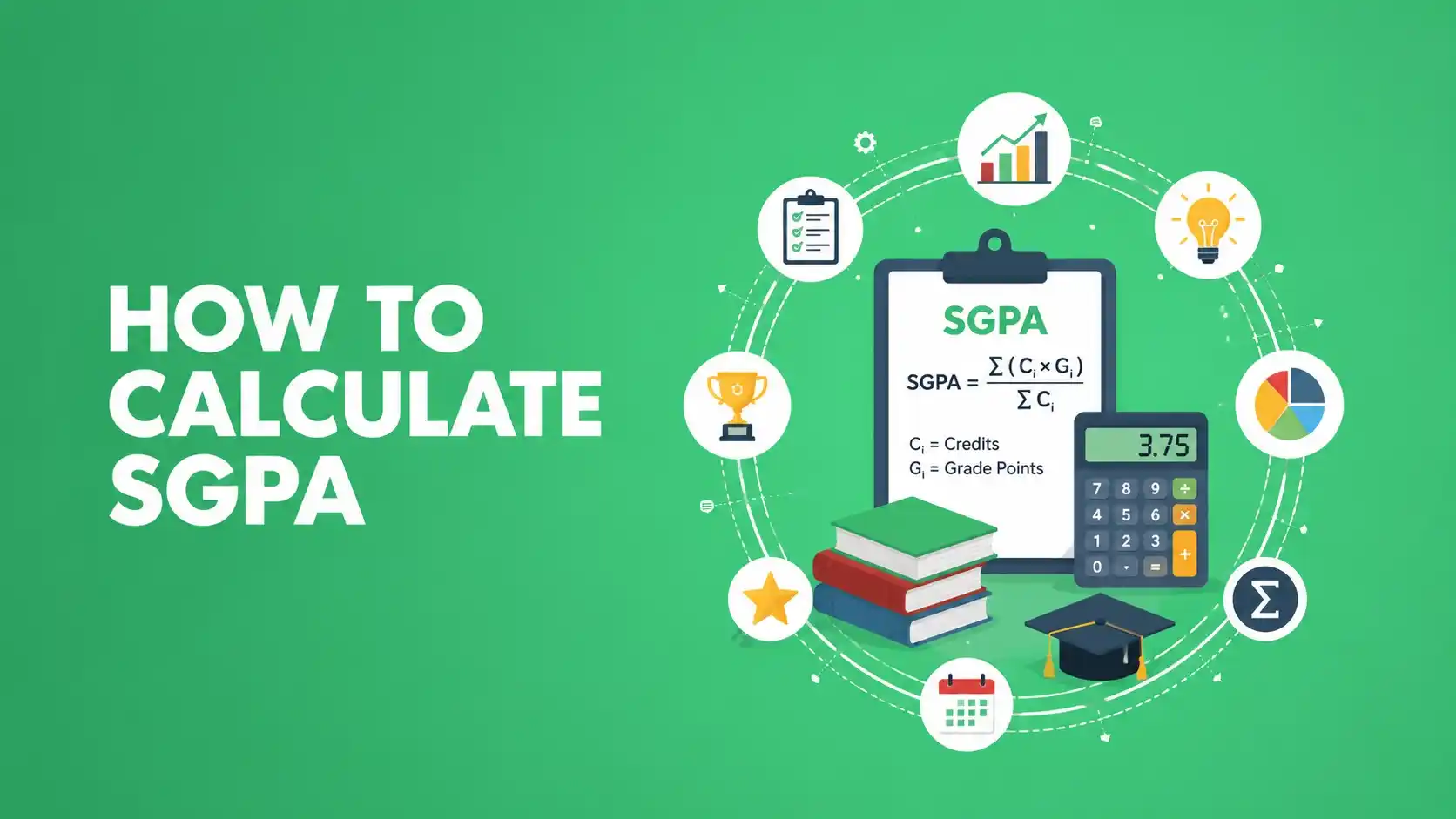
Calculating SGPA manually sounds straightforward until you’re actually doing it — multiplying grade points by credits, adding everything up, checking whether you used the right grade point for that subject, wondering if you missed a credit somewhere.
Most students get the concept but still end up second-guessing the final number.
This guide walks you through the entire process clearly — the formula, a realistic step-by-step example, common mistakes that silently give wrong results and how your SGPA connects to your overall CGPA.
By the end you’ll be able to calculate your SGPA correctly without needing to double-check every step.
If you just want the number instantly — use our free SGPA Calculator. But if you want to actually understand what you’re calculating — keep reading.
📌 Quick Navigation
- What is SGPA — And How is it Different From CGPA?
- Why Your SGPA Matters More Than You Think
- The SGPA Formula — Explained Simply
- How to Calculate SGPA — Step by Step With a Real Example
- Real Student Example — How Rohan Calculated His SGPA
- Common Mistakes That Give Students the Wrong SGPA
- SGPA vs CGPA — What’s the Actual Difference?
- How to Convert SGPA to Percentage
- How Your SGPA Directly Builds Your CGPA
- What Happens to Your SGPA When You Have a Backlog
- Tips That Actually Work for Improving Your SGPA
- How SGPA Differs Across Universities in India
- When Should You Calculate Your SGPA?
- What is Considered a Good SGPA?
- Frequently Asked Questions
- Final Thoughts
What is SGPA — And How is it Different From CGPA?
SGPA stands for Semester Grade Point Average.
In simple words:
SGPA represents your academic performance in one semester.
Instead of looking only at marks, universities calculate your performance using:
- Grade points
- Subject credits
- Weighted averages
That’s why SGPA gives a more complete picture of your academic performance—not just your raw marks.
Think of it like a semester report card in one number.
Why Your SGPA Matters More Than You Think
Many students don’t pay much attention to SGPA in the beginning.
But later, they realise it affects much more than expected.
Your SGPA can impact:
- Placement eligibility
- Higher studies applications
- Scholarships
- Your final CGPA
Think of SGPA as a building block.
Every semester adds one more piece to your academic journey, and even one good semester can make a noticeable difference later.
Quick Tip:
A strong SGPA today makes your CGPA stronger tomorrow.
The SGPA Formula — Explained Simply
Don’t worry if the formula looks complicated at first glance.
But once you understand what each part means, it actually becomes very simple.
Here’s the formula commonly used in most universities:
Formula

In simple words:
- Multiply each subject’s grade point by its credit
- Add all those values together
- Divide the total by your overall credits
That’s it—that final number is your SGPA.
How to Calculate SGPA — Step by Step With a Real Example
One of the most common questions students ask is-
‘How to Calculate SGPA?
Don’t worry—we’ll break the entire process into simple steps anyone can follow.
Step 1: Write Down Your Subjects
First, list all your subjects for the semester.
Example:
- Mathematics
- Physics
- Programming
- Electronics
Step 2: Convert Grades into Grade Points
Each grade has a corresponding grade point.
Example grading system:
| Grade | Grade Point |
|---|---|
| O | 10 |
| A+ | 9 |
| A | 8 |
| B+ | 7 |
| B | 6 |
| C | 5 |
Different universities may use slightly different systems.
Step 3: Multiply Grade Point × Credit
Now multiply each subject’s:
Grade Point × Subject Credit
Example:
| Subject | Grade Point | Credit | Total |
|---|---|---|---|
| Maths | 9 | 4 | 36 |
| Physics | 8 | 3 | 24 |
| Programming | 9 | 3 | 27 |
Step 4: Add All Values
Now add all totals together.
36 + 24 + 27 = 87
Step 5: Add Total Credits
Now add subject credits.
4 + 3 + 3 = 10
Step 6: Divide Total Points by Total Credits
SGPA = 87 ÷ 10
Final SGPA = 8.7
That’s it.
Quick Insight:
This is exactly what an SGPA calculator does automatically in seconds.
Real Student Example — How Rohan Calculated His SGPA
Let’s understand this with a situation most engineering students can relate to.
Rohan is a second year engineering student who wants to estimate his SGPA before the official results are announced. He has six subjects this semester with different credits — which is what most real semesters actually look like.
His Grades and Credits
| Subject | Grade | Grade Point | Credit | Grade Point × Credit |
|---|---|---|---|---|
| Engineering Mathematics | A+ | 9 | 4 | 36 |
| Data Structures | O | 10 | 4 | 40 |
| Digital Electronics | A | 8 | 3 | 24 |
| Physics Lab | B+ | 7 | 2 | 14 |
| Communication Skills | A | 8 | 2 | 16 |
| Environmental Science | B | 6 | 1 | 6 |
Step 1 — Add All Grade Point × Credit Values
36 + 40 + 24 + 14 + 16 + 6 = 136
Step 2 — Add All Credits
4 + 4 + 3 + 2 + 2 + 1 = 16
Step 3 — Divide
SGPA = 136 ÷ 16 = 8.5
Rohan now knows his SGPA is 8.5 — before results are even officially announced. This is exactly why understanding the formula matters. You don’t have to wait for official results to know where you stand.
Notice something from this example — Environmental Science only carries 1 credit. Even though Rohan scored B (6 points) there, the damage to his SGPA was minimal because the credit weight is low. But Data Structures with 4 credits — where he scored O — contributed 40 grade points and had the biggest positive impact.
This is why high-credit subjects matter so much more than low-credit ones.
Common Mistakes That Give Students the Wrong SGPA
This is where most students make errors.
And honestly, it happens more often than you think—especially when you calculate everything manually in a hurry.
Ignoring Credits
A 4-credit subject affects your SGPA more than a 2-credit subject.
Using Wrong Grade Points
Students often confuse:
- A with A+
- B+ with B
Even one mistake changes the final SGPA.
Manual Calculation Errors
Small multiplication mistakes can completely change your answer.
Confusing SGPA and CGPA
Many students think both are the same.
But they’re different:
- SGPA = performance of one semester
- CGPA = overall performance across semesters
The goal is not just to calculate SGPA—it’s to calculate it correctly.
A small mistake today can create unnecessary confusion tomorrow, so always check your grades, credits, and calculations carefully.
SGPA vs CGPA — What’s the Actual Difference?
This is one of the biggest sources of confusion among students—and honestly, almost everyone gets confused at first.
Let’s simplify it in the easiest way possible.
| SGPA | CGPA |
|---|---|
| Performance of one semester | Overall academic performance |
| Calculated for a single semester | Calculated across all semesters |
| Short-term academic score | Long-term academic score |
| Changes every semester | Builds gradually over time |
Think of it like this:
- SGPA = One match
- CGPA = Full tournament
A good SGPA gradually improves your CGPA.
Once you understand this difference, most SGPA-related confusion becomes much easier.
Different universities may follow different academic grading system .
How to Convert SGPA to Percentage
Most placement forms, scholarship applications and higher studies admissions ask for percentage — not SGPA.
Here’s how to convert:
Standard Formula Used by Most Universities
Percentage = SGPA × 9.5
Anna University Specific Formula
Percentage = SGPA × 10
VTU Alternative Formula
Percentage = (SGPA – 0.75) × 10
Quick Reference Table
| SGPA | Standard (×9.5) | Anna University (×10) | VTU Alt ((SGPA – 0.75) × 10) |
|---|---|---|---|
| 7.0 | 66.5% | 70% | 62.5% |
| 7.5 | 71.25% | 75% | 67.5% |
| 8.0 | 76% | 80% | 72.5% |
| 8.5 | 80.75% | 85% | 77.5% |
| 9.0 | 85.5% | 90% | 82.5% |
Always verify with your university’s official guidelines before using any formula for official forms.
Using the wrong formula can shift your percentage by 3–5% — which is enough to push you above or below a placement or scholarship cutoff you’re actually eligible for.When in doubt ask your academic department directly.
Want to convert your CGPA to percentage instead? Use our CGPA to Percentage Calculator — just make sure you select the correct formula for your university.
How Your SGPA Directly Builds Your CGPA
Your CGPA is not calculated separately from your SGPAs. It’s built entirely from them — semester by semester, weighted by the total credits each semester carries.
Here’s the Formula
CGPA = Σ(SGPA × Total Credits That Semester) ÷ Σ Total Credits Across All Semesters
Here’s What That Looks Like with Real Numbers Across 3 Semesters
| Semester | SGPA | Total Credits |
|---|---|---|
| Semester 1 | 7.2 | 20 |
| Semester 2 | 8.0 | 22 |
| Semester 3 | 8.5 | 21 |
Calculation
- Semester 1: 7.2 × 20 = 144
- Semester 2: 8.0 × 22 = 176
- Semester 3: 8.5 × 21 = 178.5
Total grade points = 498.5
Total credits = 63
CGPA = 498.5 ÷ 63 = 7.91
Notice what this means practically — Semester 1’s weak SGPA of 7.2 is still pulling the CGPA down in Semester 3 even though Rohan has improved significantly.
This is why early semester performance matters more than most students realise when they’re living through it.
The good news — a consistently strong SGPA from here pulls the CGPA up with every semester. Improvement is always possible. It just takes more time the more semesters are already behind you.
Want to calculate your CGPA from your SGPAs automatically? Use our CGPA Calculator — enter your semester-wise grades and credits to get your cumulative average instantly.
What Happens to Your SGPA When You Have a Backlog
This is the section most students wish someone had explained to them in first year.
When you fail a subject — whether it’s an F grade or a backlog — that subject contributes zero grade points to your SGPA calculation.
Zero.
Not a low score.
An actual zero — with full credit weight pulling your semester average down.
Here’s What That Means with Real Numbers
Imagine a semester with 5 subjects at 4 credits each — 20 total credits:
- 4 subjects with grade points 9, 8, 8, 7 = 128 grade points
- 1 subject with F = 0 grade points
- SGPA = 128 ÷ 20 = 6.4
Now imagine you’d just passed that subject with a C grade (5 points):
- Same 4 subjects = 128 grade points
- 1 subject with C = 20 grade points
- SGPA = 148 ÷ 20 = 7.4
One failed subject. A full point difference in your semester SGPA.
When you clear the backlog your result gets updated and your SGPA improves.
But the recovery shrinks the longer you carry it.
Clear it at the next attempt and the improvement is noticeable.
Carry it for two years and the damage is much harder to undo because more credits have accumulated around it.
Clear every backlog at the next available attempt.
The next attempt is always the right attempt — there is no convenient time to deal with it.
Tips That Actually Work for Improving Your SGPA
Improving your SGPA is not about studying 15 hours every day. It’s more about making smart and consistent decisions throughout the semester.
Focus on High-Credit Subjects First — Always
- Identify your highest credit subjects before semester starts
- Treat them as your non-negotiable priority
- One grade improvement in a 4-credit subject moves your SGPA more than two improvements in 1-credit subjects
Most students divide study time equally across all subjects. It feels fair — but mathematically it isn’t. A 4-credit subject does four times the work in your SGPA calculation.
Spend ten minutes at the start of every semester identifying which subjects carry the most credits.
Plan your effort around that, not around what feels comfortable.
Take Internal Marks Seriously from Day One
- Submit every assignment on time
- Show up prepared for every cycle test or IA
- Maintain attendance above your university’s minimum requirement
Internal marks contribute directly to your final grade — which determines the grade point that enters your SGPA calculation. Strong internals mean you need a lower end-semester exam score to reach the same grade.
Most students figure out how much this matters one semester too late.
Clear Backlogs Immediately — Never Carry Them
- An F grade contributes zero grade points with full credit weight
- The longer it sits the harder the SGPA and CGPA recovery
- Many companies disqualify active backlogs regardless of overall CGPA
There is no convenient time to clear a backlog. The next available attempt is always the right one. As the example above showed — one backlog in a 4-credit subject drops your SGPA by a full point. Don’t wait.
Study Consistently — Not Just Before Exams
- Two focused hours three times a week beats eight hours the night before
- University exam papers reward understanding over memorisation
- Questions get rephrased every year — students who understand handle that better
Practice Previous Year Question Papers
- Gives you a clear picture of what topics actually appear in exams
- Helps identify which chapters carry the most marks
- Improves time management under actual exam conditions
Previous year papers are the single most underused resource by students who are trying to improve their SGPA.
Most university exam patterns are more predictable than students realise — not because questions repeat, but because the same concepts keep appearing in different forms.
Remember:
You do not need to become a topper overnight. A small, consistent effort usually gives better long-term results than short bursts of motivation.
Want a deeper guide on improving your cumulative academic standing? Read our complete guide on How to Improve CGPA — written specifically for Indian university students.
How SGPA Differs Across Universities in India
One thing this guide needs to be honest about — the SGPA formula is the same across most Indian universities, but the grade point scale can differ.
Using the wrong grade points gives you the wrong SGPA every time. Here’s a quick reference for the most common grading scales:
| Grade | Anna University | VTU | CBSE / Most Universities |
|---|---|---|---|
| O | 10 | 10 | 10 |
| A+ | 9 | 9 | 9 |
| A | 8 | 8 | 8 |
| B+ | 7 | 7 | 7 |
| B | 6 | 6 | 6 |
| C | 5 | 5 | 5 |
| F / Fail | 0 | 0 | 0 |
Most universities use the same 10-point scale — which means the formula works identically. What changes between universities is the credit structure — how many credits each subject carries.
Always use your own university’s credit values, not a generic example from the internet.
When Should You Calculate Your SGPA?
Most students think about SGPA only after the results are announced.
But checking it earlier can actually help you stay more aware of your academic progress.
You should calculate your SGPA:
- After semester exams
- Before placement season
- While applying for higher studies
- To track your academic improvement
Knowing your SGPA early helps you make smarter academic decisions.
What is Considered a Good SGPA?
Almost every student asks this question at some point:
“Is my SGPA actually good enough?”
The truth is, a “good” SGPA can depend on your goals, branch, placements, and future plans.
But here’s a simple and realistic idea:
| SGPA Range | Performance |
|---|---|
| 9+ | Excellent |
| 8 – 9 | Very Good |
| 7 – 8 | Good |
| Below 6 | Needs Improvement |
Important:
Your SGPA is a part of your academic journey — not your entire identity. Many students improve slowly semester by semester and still build strong careers later.
Frequently Asked Questions (FAQs)
Is SGPA Difficult to Calculate?
No — but it’s easy to get wrong if you don’t pay attention to credit values. The formula itself is simple: multiply each subject’s grade point by its credit, add everything together and divide by total credits.
The mistakes happen when students use the wrong grade point, enter the wrong credit value or forget to include a subject.
Use the step-by-step guide above or the SGPA Calculator to avoid these errors.
Can I Calculate SGPA Manually?
Yes — and the guide above walks you through exactly how. You need three things for each subject:
- The grade your university assigned
- The grade point that corresponds to that grade
- The credit value of the subject
Multiply grade point by credit for each subject, add all the results together and divide by your total credits. The answer is your SGPA.
For accuracy especially before submitting anything official always verify using the calculator.
Is SGPA Important for Placements?
Yes — but indirectly. Most companies look at CGPA rather than individual semester SGPAs. But your CGPA is built from every SGPA you’ve earned.
A pattern of average or low SGPAs in early semesters creates the CGPA problem students face in third or fourth year when placements start getting real.
A strong SGPA this semester pulls your CGPA up. A weak one pulls it down. Every semester matters more than it feels like while you’re living through it.
What is the Difference Between SGPA and GPA?
In most Indian universities SGPA and GPA mean the same thing — your grade point average for one specific semester.
Some institutions and documents use GPA while others use SGPA — but the formula and meaning are identical.
CGPA — Cumulative Grade Point Average — is different. That’s the overall average across every semester you’ve completed, which never resets and is what most opportunities actually use to screen you.
Can SGPA Be Converted to a Percentage?
Yes — most Indian universities use: SGPA × 9.5 as the standard conversion formula.
Anna University uses:SGPA × 10
VTU uses either:SGPA × 9.5 or (SGPA – 0.75) × 10 depending on the context.
Always verify which formula your university officially recognises before using any converted percentage on an official form.
A full conversion table with all formulas is included in this guide above.
What Happens to My SGPA if I Fail a Subject?
A failed subject contributes zero grade points to your SGPA — but still counts toward your total credit denominator with full weight.
This means it actively pulls your semester average down. As the example in this guide shows — one failed 4-credit subject can drop your SGPA by a full point.
Once you clear the backlog your result gets updated and your SGPA improves — but the recovery shrinks the longer you wait.
Clear every backlog at the next available attempt.
How Many Semesters Does It Take to Recover a Bad SGPA?
It depends on how weak the SGPA was and how many credits that semester carried.
A single weak semester in second year can typically be recovered over two to three strong semesters — because your total credit count is still relatively low.
By fifth or sixth semester recovery takes longer because there are more credits behind you diluting the improvement.
The honest answer: start recovering immediately and don’t wait for a convenient time that never comes.
How Do I Calculate SGPA if I Don’t Have My Grade Sheet Yet?
Use your expected grades. If you have a reasonable estimate of what grade you’ll score in each subject — based on your internal marks and exam performance — enter those grade points into the SGPA Calculator above along with your credit values.
The result gives you a reliable estimate of your SGPA before official results are announced. This is exactly what Rohan did in the example above — and it’s one of the most practical uses of the SGPA calculator during result season.
Does SGPA Vary Across Different Indian Universities?
The formula is identical across most Indian universities: Σ(Grade Point × Credit) ÷ Σ Credits
What varies is the credit structure — how many credits each subject carries — and occasionally the grade point scale. Most universities use a 10-point scale where O carries 10 points and the minimum pass grade carries 5 points.
Always use your own university’s grade points and credit values when calculating — not values from a generic example online.