CGPA Formula Explained: Complete Step-by-Step Guide for Students (2026)
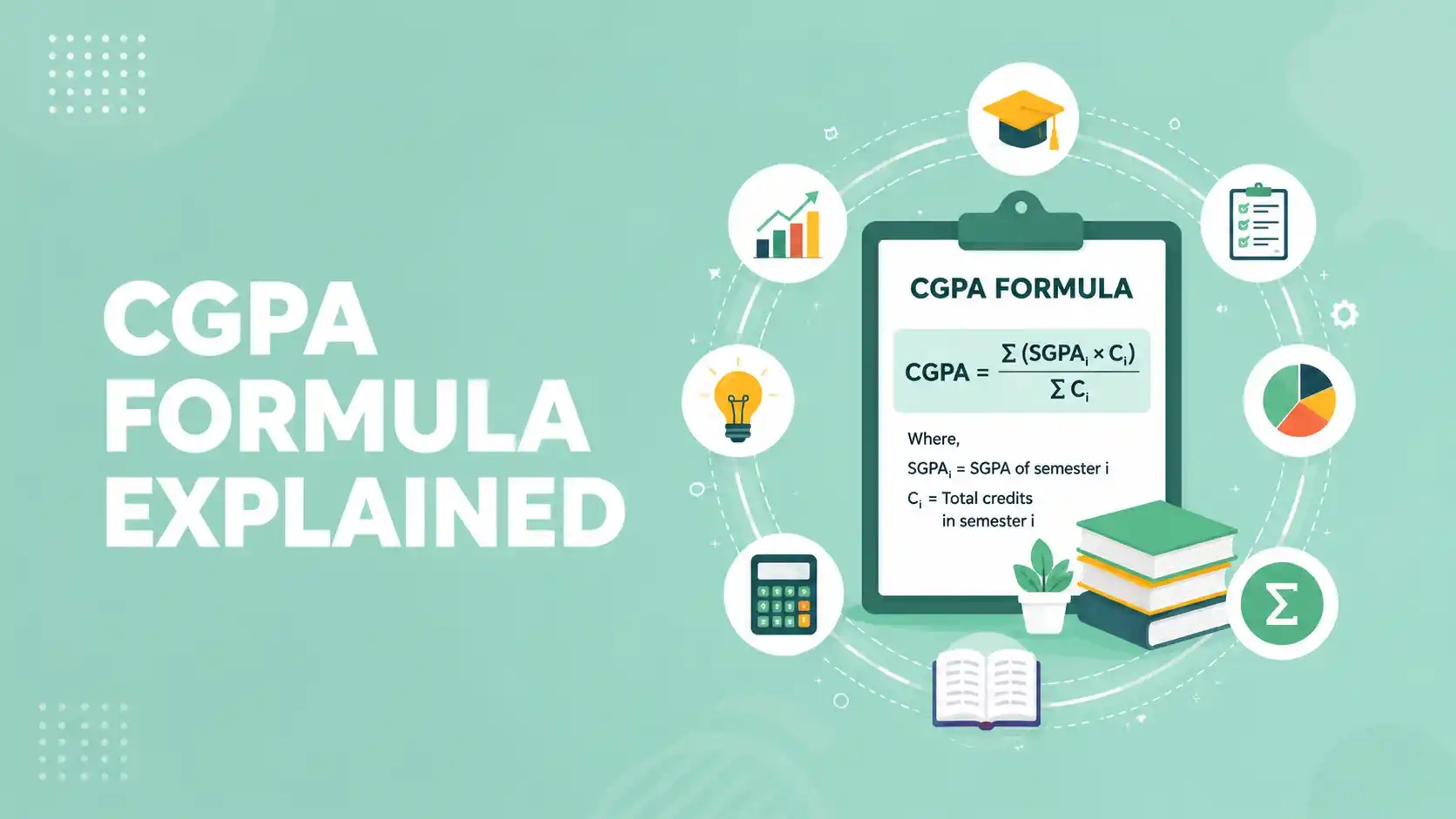
The CGPA formula looks intimidating the first time you see it — grade points, credits, weighted averages, sigma symbols.
But once you understand what each part actually means, it becomes one of the simplest calculations in your academic life.
Most students who struggle with CGPA aren’t struggling with the math.
They’re struggling because nobody explained what credits actually do in the formula, why multiplying grade points by credits matters and how one subject with more credits can affect your CGPA more than three subjects with fewer credits combined.
This guide explains all of that clearly — with a real step-by-step example, university-specific grade point scales and the mistakes that silently give students wrong results.
By the end you’ll understand exactly how your CGPA is built and what you can do to change it.
A Real Student Story
Here’s a situation that plays out across Indian colleges more often than students realise.
Arjun was a third year engineering student who understood his grades well — O means 10, A+ means 9, A means 8. He’d been calculating his CGPA manually for two semesters and consistently got around 8.1. When his official results came out his CGPA was 7.8.
He went back through his calculation and found the issue. He’d been treating all subjects equally — adding up all grade points and dividing by the number of subjects.
He hadn’t multiplied each grade point by its credit value first. His Mathematics subject — which he scored A in — carried 4 credits. His Communication Skills subject — which he scored O in — carried only 1 credit.
In his manual calculation both subjects had equal weight. In the actual formula Mathematics was doing four times more work. That 0.3 gap between what he calculated and what his marksheet showed came entirely from ignoring credit weight across two semesters.
The formula isn’t complicated. But every part of it matters.
📌 Quick Navigation
- What is CGPA — And What Does the Formula Actually Calculate?
- The CGPA Formula — What Each Part Actually Means
- Understanding Grade Points — And How They Differ Across Universities
- Grade Point Scales Across Indian Universities
- What Are Credits — And Why Do They Change Everything?
- How to Calculate CGPA — Step by Step With a Real Example
- What Happens to the CGPA Formula When You Have a Backlog
- Common Mistakes That Give Students the Wrong CGPA
- CGPA vs SGPA — The Clearest Way to Understand the Difference
- Why Your CGPA Actually Matters — And For How Long
- How to Actually Improve Your CGPA
- How to Convert CGPA to Percentage
- How to Convert Percentage Back to CGPA
- What is Considered a Good CGPA?
- Frequently Asked Questions
- Final Thoughts
What is CGPA — And What Does the Formula Actually Calculate?
CGPA stands for Cumulative Grade Point Average.
In simple words, CGPA is a number that shows your overall academic performance across all semesters and subjects.
Most schools, colleges, and universities use CGPA to measure how consistently a student performs over time.
CGPA is part of a broader grading system used in education worldwide. If you want to understand how academic grading systems work globally, you can read this detailed guide on grading in education.
You can think of CGPA as your academic “overall score.”
That’s why CGPA matters in:
- Placements
- Higher studies
- Scholarships
- Internships
- Competitive applications
- Academic evaluations
A good CGPA can create opportunities, while a low CGPA may sometimes limit certain options.
The CGPA Formula — What Each Part Actually Means
Don’t worry if the formula looks confusing at first. It becomes very simple once you understand what each part means.
Here’s the formula used in most universities.
CGPA Formula
CGPA = Σ (Grade Point × Credit) ÷ Σ Total Credits
In simple words:
- Multiply each subject’s grade point by its credit.
- Add all those values together.
- Divide the total by the overall credits.
That’s it — the final number is your CGPA.
Understanding Grade Points — And How They Differ Across Universities
Before calculating CGPA, it is important to understand what grade points actually mean.
In most universities, marks are not used directly in the CGPA formula. Instead, your marks are converted into grade points based on your performance in each subject.
A simple grading system may look like this:
| Grade | Grade Point |
|---|---|
| O | 10 |
| A+ | 9 |
| A | 8 |
| B+ | 7 |
| B | 6 |
| C | 5 |
| F | Fail |
Different universities may follow slightly different grading systems, but the basic idea remains the same.
These grade points are then used in the CGPA formula to calculate your overall academic performance.
Grade Point Scales Across Indian Universities
Most Indian universities use the same 10-point grade point scale — but the letter grades and their corresponding points can vary slightly between institutions.
Using the wrong grade point for your university gives you the wrong CGPA every time.
Here’s a reference for the most common systems:
| Grade | Anna University | VTU | CBSE / Most Universities |
|---|---|---|---|
| O (Outstanding) | 10 | 10 | 10 |
| A+ (Excellent) | 9 | 9 | 9 |
| A (Very Good) | 8 | 8 | 8 |
| B+ (Good) | 7 | 7 | 7 |
| B (Average) | 6 | 6 | 6 |
| C (Satisfactory) | 5 | 5 | 5 |
| F (Fail) | 0 | 0 | 0 |
Most universities follow the same scale — which means the CGPA formula works identically across institutions. What changes is the credit structure — how many credits each subject carries.
Always use your own university’s credit values when calculating, not values from a generic example online.
What Are Credits — And Why Do They Change Everything?
Credits are the part of the CGPA formula that most students either don’t understand or completely ignore — and it’s why their manual calculation often doesn’t match the official result.
Here’s what credits actually represent: the academic weight of a subject.
A subject that meets three times a week, involves practical work, has assignments and carries more assessment load gets more credits than a subject that meets once a week for theory only.
Credits reflect how much of your academic energy a subject is supposed to demand.
How Credits Affect the CGPA Formula
In the CGPA formula this matters directly: Grade Point × Credit
This multiplication gives each subject its proper influence on your final average. A 4-credit subject contributes four times more to your CGPA than a 1-credit subject.
A grade improvement in a 4-credit subject moves your CGPA far more noticeably than the same grade improvement in a 1-credit subject.
Here’s What That Looks Like Practically
| Scenario | Subject | Grade Point | Credit | Contribution |
|---|---|---|---|---|
| Student A scores O | Mathematics (4 credits) | 10 | 4 | 40 points |
| Student B scores O | Communication (1 credit) | 10 | 1 | 10 points |
Same grade. Same grade point. Four times the CGPA impact just because of credit weight.This is why the CGPA formula uses multiplication — not to make it complicated, but to make it fair.
High-credit subjects carry more weight because they demand more from you. The formula reflects that.
How to Calculate CGPA — Step by Step With a Real Example
Let’s work through a complete semester with six subjects — which is what most real semesters actually look like at Indian universities.
Neha’s Semester Grades and Credits
| Subject | Grade | Grade Point | Credit | Grade Point × Credit |
|---|---|---|---|---|
| Engineering Mathematics | A+ | 9 | 4 | 36 |
| Data Structures | O | 10 | 4 | 40 |
| Digital Electronics | A | 8 | 3 | 24 |
| Physics Lab | B+ | 7 | 2 | 14 |
| Communication Skills | A | 8 | 2 | 16 |
| Environmental Science | B | 6 | 1 | 6 |
Step 1 — Multiply Grade Point × Credit for Each Subject
36 + 40 + 24 + 14 + 16 + 6 = 136
Step 2 — Add All Credits
4 + 4 + 3 + 2 + 2 + 1 = 16
Step 3 — Divide
CGPA = 136 ÷ 16 = 8.5
Now notice something important from this example. Environmental Science — where Neha scored B (6 points) — only carries 1 credit. Its negative impact on her CGPA was minimal because the credit weight is low.
But Engineering Mathematics and Data Structures — both carrying 4 credits — had the biggest influence on her final number. If Neha had scored B+ instead of O in Data Structures — dropping from 10 to 7 grade points in a 4-credit subject — her CGPA would have dropped from 8.5 to 8.125.
A single grade drop in one high-credit subject. This is the entire logic behind why high-credit subjects matter so much more than low-credit ones. The formula isn’t treating them unfairly — it’s reflecting how much time, work and academic weight each subject actually carries.
What Happens to the CGPA Formula When You Have a Backlog
This is the section most students wish someone had explained clearly in first year.
When you fail a subject — receiving an F grade — that subject contributes zero grade points to the formula. But here’s what most students miss: it still counts toward your total credit denominator with full weight.
This Means the Formula Looks Like This for a Student with One Backlog
Without backlog (all 6 subjects passed):
CGPA = 136 ÷ 16 = 8.5
With one 4-credit backlog replacing Data Structures (O → F):
- Data Structures contributes 0 instead of 40 grade points
- New total = 136 – 40 = 96 grade points
- Credits still = 16 (the failed subject still counts)
CGPA = 96 ÷ 16 = 6.0
One failed 4-credit subject. A drop from 8.5 to 6.0 in the same semester.
This is why backlogs are so damaging — not just because you failed, but because the formula counts the credits of the failed subject while giving you zero benefit from them.
When you clear the backlog your result gets updated — the zero gets replaced with your actual grade point and your CGPA improves.
But the recovery shrinks the longer you carry it because more credits accumulate around it across subsequent semesters.
Clear every backlog at the next available attempt.The formula doesn’t forget — it just quietly keeps pulling your average down until you do.
Common Mistakes That Give Students the Wrong CGPA
Calculating CGPA is not difficult, but small mistakes can easily lead to the wrong result.
Ignoring Credits
Students sometimes directly average grades without considering credits.
Using Wrong Grade Points
Confusing:
- A with A+
- B with B+
…can change the final CGPA.
Calculation Mistakes
Even small multiplication errors affect results.
Confusing CGPA with SGPA
Many students use their semester SGPA as their overall CGPA.
This creates confusion during:
- Placements
- Applications
- Resume building
Reality Check:
Many students realise these mistakes only after calculating their CGPA multiple times and getting different results.
CGPA vs SGPA — The Clearest Way to Understand the Difference
This is one of the most common points of confusion among students.
Many students think CGPA and SGPA are the same, but they have different purposes.
Let’s simplify it clearly.
| SGPA | CGPA |
|---|---|
| Semester performance | Overall performance |
| Calculated for one semester | Calculated for all semesters |
| Short-term score | Long-term academic score |
💡 Simple understanding:
- SGPA = One semester
- CGPA = Entire academic journey
For example, if you score well in one semester, your SGPA may become high. But your CGPA depends on the combined performance across all semesters.
Want to calculate your semester SGPA separately before adding it to your overall CGPA? Use our free SGPA Calculator — enter your subject grades and credits to get your semester average instantly.
Why Your CGPA Actually Matters — And For How Long
Many students do not take CGPA very seriously during their early semesters.
Later, many students realise how important CGPA is for placements, internships, scholarships, and higher education.
It affects:
- Placements
- Higher studies admissions
- Scholarships
- Academic profile
In fact, many companies and universities set minimum CGPA eligibility criteria before students can even apply.
A low CGPA can sometimes limit opportunities. That’s why maintaining a good CGPA matters.
How to Actually Improve Your CGPA
Improving CGPA does not always mean studying harder — but small changes in study habits can make a big difference over time.
Prioritise High-Credit Subjects Above Everything Else
- Identify your highest credit subjects before semester starts
- Treat them as non-negotiable priority
- One grade improvement in a 4-credit subject moves CGPA more than two improvements in 1-credit subjects
As the examples in this guide show — the formula multiplies grade points by credits. This means your time and effort are literally worth more in high-credit subjects. Spreading effort equally across all subjects feels fair but mathematically works against you.
Clear Every Backlog at the Next Available Attempt
- An F grade contributes zero grade points with full credit weight
- It actively pulls your CGPA down every semester it stays uncleared
- The recovery shrinks the longer you carry it
The backlog example above showed a drop from 8.5 to 6.0 in one semester from one failed subject. That damage compounds quietly across semesters until the backlog is cleared.
Next attempt is always the right attempt.
Take Internal Assessment Marks Seriously
- Internals contribute directly to your final grade
- A strong IA score means you need a lower exam score to reach the same grade point
- Assignments and cycle tests are free grade points most students ignore
The grade point that enters the CGPA formula comes from your final grade — which includes internals. Students who do well in internals consistently achieve higher grade points than those who rely entirely on exam performance.
Track Your CGPA After Every Semester — Not Just Before Placements
- Use the formula above after every result
- Identify which subjects pulled your average down
- Knowing your number early gives you time to act
The students who manage CGPA well aren’t necessarily studying more. They’re paying attention consistently — which gives them options that students who only check before placements simply don’t have.
Study Consistently Throughout the Semester
- Two focused hours three times a week outperforms eight hours the night before
- University papers reward understanding over memorisation
- Concepts get applied differently every year — understanding handles that better
Remember This:
CGPA improvement doesn’t happen overnight—it improves gradually through consistency and smarter study habits.
Want a deeper guide on improving your academic standing semester by semester? Read our complete guide on How to Improve CGPA — written specifically for Indian university students.
How to Convert CGPA to Percentage
Many students need a percentage for:
- Placements
- Scholarship forms
- Competitive exams
- Higher studies applications
The most common formula used in India is:
Formula
Percentage = CGPA × 9.5
Example
CGPA = 8.0
Percentage = 8 × 9.5
Percentage = 76%
Some universities may use different formulas, so always verify official guidelines.
You can try our CGPA to Percentage Calculator to instantly convert CGPA into percentage.
How to Convert Percentage Back to CGPA
Sometimes students already have a percentage and need CGPA instead.
Formula
CGPA = Percentage ÷ 9.5
Example
Percentage = 76%
CGPA = 76 ÷ 9.5
CGPA = 8.0
If you don’t want to calculate it manually, use our free Percentage to CGPA Calculator.
What is Considered a Good CGPA?
This is one of the most common questions students ask:
“Is my CGPA good enough?”
The honest answer is that a “good” CGPA can vary depending on your goals, university, and career plans.
However, most colleges and companies generally view CGPA like this:
| CGPA | Performance |
|---|---|
| 9+ | Outstanding |
| 8–9 | Excellent |
| 7–8 | Good |
| Below 6 | Needs Improvement |
Important thing to remember:
CGPA matters—but it is not the only thing that defines your future. Skills, communication, projects, consistency, and practical knowledge matter too.
Frequently Asked Questions (FAQs)
Is CGPA Difficult to Calculate?
No — but it’s easy to get wrong if you ignore credit weight. The formula itself is straightforward:
Multiply each subject’s grade point by its credit, add everything together and divide by total credits.
The mistakes happen when students average grade points without multiplying by credits first — like Arjun in the story above.
Once you understand what each part of the formula does the calculation becomes quick and reliable.
Why Are Credits Important in CGPA?
Credits determine how much influence each subject has on your final CGPA.
A 4-credit subject contributes four times more to your average than a 1-credit subject — because the formula multiplies grade point by credit before adding everything together.
This is why a grade improvement in a high-credit subject moves your CGPA noticeably while the same improvement in a low-credit subject barely makes a dent.
Credits make the formula fair — not complicated.
Can I Calculate CGPA Manually?
Yes — and the step-by-step guide above walks you through exactly how. You need three things for each subject:
- The grade your university assigned
- The grade point that corresponds to that grade on your university’s scale
- The credit value of the subject
Multiply grade point by credit for each subject, add all results together and divide by total credits. For accuracy — especially before submitting anything official — verify using our free CGPA Calculator.
Is CGPA Important for Placements?
Yes — specifically as an entry filter. Most companies visiting Indian college campuses set a minimum CGPA cutoff between 6.5 and 7.5.
Your application doesn’t get reviewed if you fall below it regardless of your skills or projects. Once you’re past the cutoff CGPA stops being the deciding factor and everything else takes over.
The goal isn’t a perfect score — it’s clearing the threshold of the companies you’re actually targeting.
Can CGPA Improve Later?
Yes — and earlier is always better. Since CGPA is a cumulative weighted average strong performance in upcoming semesters gradually pulls your number up.
The improvement is more visible when fewer semesters are behind you — a strong third semester improves your CGPA more noticeably than a strong seventh semester because there’s less history diluting it.
Clearing backlogs also improves your CGPA immediately once the updated result is processed.
What Happens to the CGPA Formula if I Fail a Subject?
A failed subject contributes zero grade points to the formula — but it still counts toward your total credit denominator with full weight. This means it actively pulls your CGPA down without giving you any benefit from those credits.
As the example in this guide shows — one failed 4-credit subject can drop a semester average from 8.5 to 6.0.
When you clear the backlog the zero gets replaced with your actual grade point and your CGPA improves.
The longer you carry it the harder the recovery.
How is the CGPA Formula Different from the SGPA Formula?
The formula is identical: Σ(Grade Point × Credit) ÷ Σ Credits
The difference is in what you include. For SGPA you only include subjects from one semester. For CGPA you include subjects from every semester you’ve completed — which is why CGPA is cumulative and never resets while SGPA resets each semester.
A strong SGPA this semester pulls your CGPA up. A weak one pulls it down. Every semester’s SGPA gets folded into your CGPA weighted by that semester’s total credits.
Does the CGPA Formula Change Across Different Indian Universities?
The formula itself: Σ(Grade Point × Credit) ÷ Σ Credits is the same across virtually every Indian university.
What changes is the grade point scale and the credit structure. Most universities use a 10-point scale where O carries 10 points and the minimum pass grade carries 5 points.
Some use slightly different letter grades. The credit values per subject also vary by university and scheme.
Always use your own university’s grade points and credit values — not generic values from an example online.
Why Does My Calculated CGPA Differ from My Official CGPA?
This happens for three common reasons.
- You averaged grade points without multiplying by credits first
- You forgot to include a failed subject which contributes zero grade points but still counts toward total credits
- You used the wrong grade point for a subject — for example entering 8 for a B+ when your university’s scale gives B+ a value of 7
Cross-check your calculation step by step using the guide above and verify each subject’s grade point against your university’s official scale.
What is the Difference Between CGPA and Percentage?
CGPA is a grade point average on a 10-point scale calculated using the weighted formula. Percentage is your marks expressed as a score out of 100.
Most Indian universities convert CGPA to percentage using a multiplication formula — the most common being CGPA × 9.5.
- Anna University uses CGPA × 10
- Mumbai University uses (CGPA × 7.1) + 11
These are conversion estimates — not exact translations — because the two systems measure performance differently.
Always verify which formula your university officially uses before converting for any official form.