How to Improve CGPA: Practical Tips Every Student Should Follow (2026 Guide)
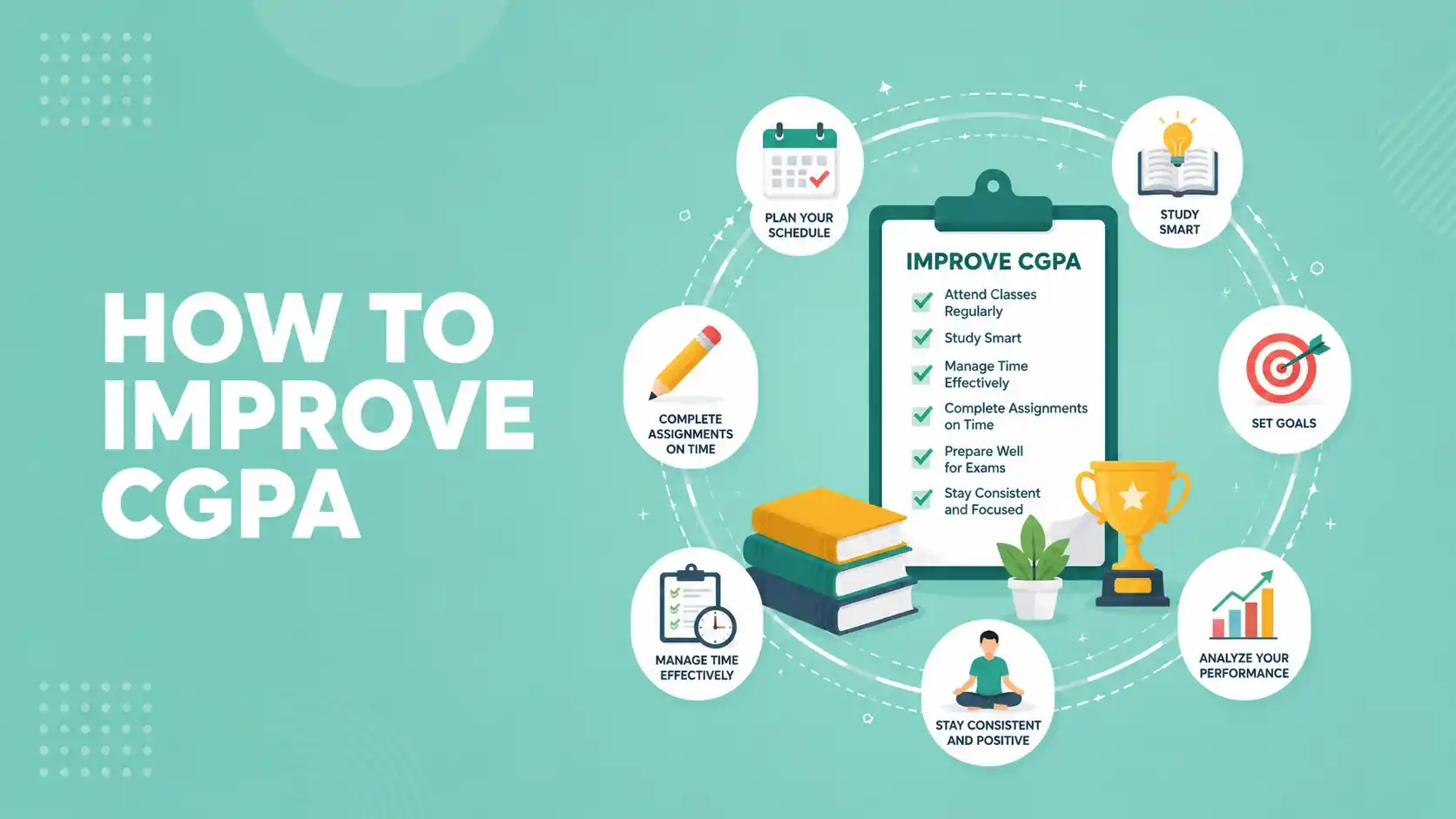
Most students who want to improve their CGPA already know the generic advice — study more, attend classes, revise regularly. The problem isn’t knowing what to do.
The problem is that generic advice doesn’t tell you which specific actions actually move your CGPA number and which ones just feel productive without doing much.
This guide is different. It covers the specific decisions that actually change your CGPA — why high-credit subjects matter more than low-credit ones mathematically, how one uncleared backlog quietly does more damage than most students realise, what realistic improvement looks like across different starting points and what the students who successfully recovered their CGPA consistently did differently.
If you’re looking for motivation — this guide has some of that too. But mostly it’s about specific, actionable things you can do starting this semester that will show up in your CGPA by the next one.
A Real Student Story
Here’s a story that plays out across Indian colleges every year — and it’s worth reading before the tips because it changes how you think about improvement.
Nikhil was a second year mechanical engineering student at a VTU affiliated college in Bangalore. After his first two semesters his CGPA was 6.1. He had two backlogs, irregular attendance and a habit of cramming two nights before every exam.
He wasn’t a bad student. He was just doing everything slightly wrong. In third semester he made three specific changes.
- He identified his two highest credit subjects — Engineering Mathematics and Machine Design — and spent 60% of his study time on those two subjects alone
- He cleared both backlogs in the supplementary exam before third semester results
- He stopped studying the night before exams and used that time for sleep instead
Third semester SGPA: 7.8
Fourth semester SGPA: 8.1
CGPA after four semesters: 7.2
He went from 6.1 to 7.2 in two semesters.
Not by studying harder in a general sense — by making three specific decisions that the CGPA formula actually rewards.
That’s what this guide is about.
📌 Quick Navigation
- Why Your CGPA Actually Matters — And For How Long
- What Students Who Successfully Improved Their CGPA Did Differently
- 1. Prioritise High-Credit Subjects Above Everything Else
- 2. Understand the Concept — Don’t Just Memorise the Answer
- 3. Study Consistently — Not Just Before Exams
- 4. Practise Previous Year Question Papers — Properly
- 5. Clear Backlogs Immediately — Every Single One
- 6. Manage Your Semester — Not Just Your Study Hours
- 7. Make Short Notes — Then Actually Use Them
- 8. Address Weak Subjects Early — Don’t Wait Until Finals
- 9. Track Your CGPA Every Semester — Not Just Before Placements
- 10. Protect Your Sleep and Energy — Not as Wellness Advice But as Performance Advice
- University-Specific Things Worth Knowing
- Common Mistakes That Quietly Prevent CGPA Improvement
- How Much Can You Realistically Improve Your CGPA?
- How CGPA Affects Campus Placements — The Honest Picture
- How CGPA Affects Higher Studies — India and Abroad
- Practical Daily Routine to Improve CGPA
- Frequently Asked Questions
- Final Thoughts
Why Your CGPA Actually Matters — And For How Long
Most students treat CGPA as something to worry about later. Usually that means worrying about it during placement season when there’s very little left to change.
Here’s where it actually matters — before you reach that point:
Campus Placements
Every company visiting your college uses CGPA as the first filter. Not because 7.2 students are worse than 7.5 students — but because they need to cut 500 applications down to 50 quickly.
Your CGPA determines whether you get seen. Skills matter after that. But you need to clear the filter first.
Higher Studies
Planning for MTech, MBA or a master’s abroad?
CGPA is the first thing evaluated. A declining CGPA trend in later semesters raises questions even if the final number looks acceptable. Consistency across semesters tells a better story than one strong final year.
Scholarships and Internships
Most merit-based opportunities have minimum CGPA requirements. A number you ignored in second semester can quietly close a door you wanted open in fourth.
The Window Where It Matters Most
After your first job CGPA becomes largely irrelevant. Work experience and skills take over. But during that initial window — your first job, your first internship, your first postgraduate application — it’s the most visible thing on your profile.
Protect it during the window when it counts. . After that let your work speak for itself.
What Students Who Successfully Improved Their CGPA Did Differently
Many students think improving their CGPA means studying for endless hours every single day.
But in reality, that’s not the truth.
Improving CGPA is more about building smart and consistent habits over time.
It usually comes down to:
- Studying regularly
- Understanding concepts instead of memorising everything
- Managing time better during the semester
- Learning from mistakes and avoiding them repeatedly
The good news is that you do not need perfect semesters to improve your CGPA.
Even small improvements each semester can slowly create a strong final academic profile.
1. Prioritise High-Credit Subjects Above Everything Else
This is the single most impactful decision you can make for your CGPA — and most students never think about it this way.
The CGPA formula multiplies each subject’s grade point by its credit value before averaging. This means a 4-credit subject does four times the work in your CGPA calculation compared to a 1-credit subject. A grade improvement from B+ to A in a 4-credit subject improves your CGPA noticeably. The same improvement in a 1-credit subject barely moves the number.
Here’s What That Looks Like With Real Numbers
Imagine a semester with 6 subjects — two at 4 credits, two at 3 credits, one at 2 credits and one at 1 credit — 17 total credits.
If you improve your grade from B+ (7) to A (8) in a 4-credit subject:
- Grade point improvement = 1 point × 4 credits = 4 extra points
- SGPA improvement = 4 ÷ 17 = 0.24 SGPA improvement
If you improve the same grade in the 1-credit subject:
- Grade point improvement = 1 point × 1 credit = 1 extra point
- SGPA improvement = 1 ÷ 17 = 0.06 SGPA improvement
Same effort. Four times the result — just by knowing which subject to focus on.
What to Do Right Now
Before this semester starts — or right now if it’s already running — look at your subject list and identify the two or three subjects with the highest credits.
Those are your non-negotiable priorities. Everything else fits around them.
Not sure which of your subjects carry the most credits? Use our free CGPA Calculator — enter your grades and credits to see exactly how each subject is affecting your overall average.
2. Understand the Concept — Don’t Just Memorise the Answer
This tip sounds obvious. Most students nod along and then go back to memorising their textbook. So let’s be specific about why this actually matters for CGPA.
Indian university exam papers get reworded every year. The same concept appears in a different scenario, a different application or a different format. Students who memorised the answer from last year’s paper see an unfamiliar question and panic. Students who understood the concept see a familiar idea in new clothes and answer confidently.
The grade point difference between a student who understood and a student who memorised the same chapter — on the same exam — is often one full grade. B+ instead of A. Or A instead of O. In a 4-credit subject that single grade difference moves your CGPA by 0.24 points as shown above.
Understanding also compounds over semesters. Concepts from second semester appear in third and fourth semester subjects. Students who built real understanding early find later semesters significantly easier than students who memorised their way through.
How to Build Understanding Rather Than Memorising
- After reading a concept — close the book and explain it in your own words
- If you can’t explain it simply you haven’t understood it yet
- Practise applying the concept to problems you haven’t seen before
- Use previous year papers not to memorise answers but to test whether you can apply concepts to new questions
3. Study Consistently — Not Just Before Exams
Every student knows cramming isn’t ideal. Most students do it anyway. So let’s be honest about why consistency actually works better — not just in theory but in the specific context of Indian university exams.
Your brain retains information through repetition over time — not through intensity in a single session.
When you study a topic once in week two and review it briefly in week four and again before the exam — you remember it significantly better than a student who studied the same topic for four hours the night before.This isn’t motivation — it’s how memory actually works.
The other reason consistency matters for CGPA specifically — internal assessment marks. Most Indian universities have cycle tests, IA tests or internal exams that contribute directly to your final grade. These happen throughout the semester. Students who study consistently are prepared for them. Students who only study before finals often miss internal marks that no amount of end-semester effort can recover.
A student who scores 45/50 in internals needs to score 55/100 in the end-semester to reach a particular grade. A student who scored 25/50 in internals needs to score 75/100 in the same exam to reach the same grade.That 20-mark gap in the end-semester is genuinely difficult to close under exam pressure.
What Actually Works
- 1.5 to 2 focused hours daily — not 8 hours before the exam
- Review topics from previous weeks briefly every weekend
- Treat internal tests with the same seriousness as end-semester exams
- Cover your highest-credit subjects first in every study session
4. Practise Previous Year Question Papers — Properly
Most students know previous year papers are useful. Most students also use them wrong.
The Wrong Way
Reading through answers from old papers and thinking “okay I know this.” This is passive — you’re recognising information, not retrieving it.Recognition doesn’t help you in an exam.
The Right Way
Close your notes, set a timer and attempt the paper under exam conditions. Then check your answers. The topics where you struggled — those are your gaps. The topics where you answered confidently — those are your strengths. This tells you exactly where to spend the remaining time before your exam.
Previous year papers also show you which topics appear repeatedly across years. Every Indian university has a core set of concepts that show up consistently — worded differently but testing the same understanding. Students who identify these topics and master them go into exams significantly more prepared than those who try to cover everything equally.
Practical Approach
- Start practising papers at least 3–4 weeks before your exam — not the night before
- Attempt each paper under time pressure — don’t just read through it
- For subjects with numerical problems — do every calculation from scratch without looking at solutions
- Use the patterns you find to prioritise your remaining preparation time
5. Clear Backlogs Immediately — Every Single One
This is the most impactful single action a student with a low CGPA can take.
And it’s the one most students put off the longest.
Here’s the mathematical reality that most students don’t fully understand.
A failed subject contributes zero grade points to your CGPA — but it still counts toward your total credit denominator with full weight.This means a backlog actively pulls your CGPA down without giving you any benefit from those credits.
Here’s What That Means in Real Numbers
Imagine a semester with 5 subjects at 4 credits each — 20 total credits:
- 4 subjects with grade points 8, 8, 7, 7 = 120 grade points
- 1 subject with F = 0 grade points
Semester GPA = 120 ÷ 20 = 6.0
If you’d passed that subject with just a C grade (5 points):
- Same 4 subjects = 120 grade points
- 1 subject with C = 20 grade points
Semester GPA = 140 ÷ 20 = 7.0
One backlog. Same credits. A full point difference in your semester GPA.
When you clear the backlog your result gets updated and your CGPA improves. But the recovery shrinks the longer you carry it — because more credits accumulate around it with every passing semester making the improvement smaller and smaller.
Beyond the CGPA Impact
Many companies specifically disqualify students with active backlogs during placement registration regardless of their overall CGPA. A student with 7.5 CGPA and one active backlog may be ineligible for companies that a student with 7.2 CGPA and zero backlogs qualifies for.
Clear every backlog at the next available attempt.Not the one after that. The next one.
Want to see exactly how much clearing a backlog would improve your CGPA? Use our SGPA Calculator — enter your subjects including the cleared backlog grade to see the improvement instantly.
6. Manage Your Semester — Not Just Your Study Hours
Time management advice usually comes as a list of habits — make a schedule, avoid your phone, study difficult subjects first. These aren’t wrong. But for CGPA improvement specifically the more useful version of time management advice is this:
Manage your semester as a whole, not just individual days.
Here’s What That Means Practically
Most students think about exams two to three weeks before they happen.
Students who improve their CGPA think about their semester performance from week one — specifically which subjects are high-credit, which internal tests are coming up, which topics from previous semesters are likely to appear in current subjects and where they’re already falling behind.
This kind of semester-level awareness lets you make adjustments early — when there’s still time to change the outcome. Students who only notice problems at the end of the semester react to results.
Students who track mid-semester can still influence them.
Practical Semester Management
- In week one — list all your subjects with credit values and all internal assessment dates
- Identify your two highest-credit subjects and block more time for them from the start
- Check your internal marks after each test — not just to know the score but to identify which topics hurt you
- If you’re falling behind in a high-credit subject before week six — treat it as urgent, not something to catch up on before finals
7. Make Short Notes — Then Actually Use Them
Most students make notes. Most students never open them again until the night before the exam when there’s too much to review and not enough time.
The purpose of short notes isn’t to create something beautiful.It’s to create a tool you actually use for revision. One page of key formulas, definitions and important points for each chapter — made in your own words, not copied from the textbook — is far more useful than 20 pages of notes that take three hours to read through.
For CGPA improvement specifically — revision matters because internal tests and cycle tests happen throughout the semester. A student who reviews their short notes briefly every weekend is consistently prepared for these tests. A student who only makes notes and never revisits them scores lower on internals than their preparation deserves.
What Actually Works
- After each class or study session write down the three or four most important points — not a summary of everything
- Use your own words — not the textbook’s
- Review your notes from the previous week every weekend — takes 20 minutes but dramatically improves retention
- Before any internal test — your short notes are all you need for the final review
8. Address Weak Subjects Early — Don’t Wait Until Finals
Most students know which subjects they’re struggling in by week three or four of the semester. Most students do nothing about it until week twelve when the final exam is two weeks away.
By week twelve a subject you’ve been avoiding for eight weeks is genuinely difficult to recover. The concepts are unfamiliar, the numerical practice is minimal and you’re now competing for time with four or five other subjects that also need attention.
The same subject addressed in week four — when you first notice the struggle — is manageable. One session with a professor, one afternoon with a classmate who understands it better or two hours watching clear explanations online can shift your understanding enough to make the rest of the semester significantly easier.
The CGPA impact of addressing a weak high-credit subject early versus late is significant. A student who catches a struggling A-grade subject in week four and brings it to O has recovered a full grade point in a high-credit subject. A student who only notices the problem in week twelve often ends up at the same grade they were already heading toward.
The moment you notice you’re struggling in a high-credit subject — treat it as urgent. One week of early attention is worth more than four weeks of last-minute effort.
9. Track Your CGPA Every Semester — Not Just Before Placements
The students who manage CGPA well consistently share one habit — they know their number at every point in the semester, not just when results come out.
This matters because CGPA is cumulative. Every semester’s performance gets locked in permanently once results are announced. A student who checks their CGPA only before placements is reacting to a number they can no longer change.A student who tracks mid-semester still has time to influence the outcome.
Tracking doesn’t mean obsessing. It means: after your internal marks come out — use the SGPA calculator to estimate where your semester is heading. If you’re on track — stay consistent.
If you’re below where you need to be — you still have time to push harder in the subjects that matter most before finals.
What to Track Every Semester
- Internal marks in each subject — as they come out, not at the end
- Your estimated SGPA based on current internal performance
- Which subjects are below your target grade and how much that’s affecting your projected CGPA
- Your cumulative CGPA after each semester’s official results
Use our CGPA Calculator to calculate your current standing after every semester result. And use our SGPA Calculator mid-semester to estimate where you’re heading before results are announced.
10. Protect Your Sleep and Energy — Not as Wellness Advice But as Performance Advice
This tip usually gets dismissed as generic wellness advice. So let’s frame it differently.
Your ability to focus, retain information and perform under pressure during exams is directly affected by sleep quality.
This isn’t motivational — it’s physiology.
A student who slept 5 hours the night before an exam performs measurably worse on tasks requiring memory and concentration than the same student who slept 7.5 hours — even if the sleep-deprived student spent those extra 2.5 hours studying.
For CGPA improvement specifically this means: The habit of studying until 2am before exams is almost certainly costing you marks — not because the studying isn’t valuable but because the sleep deprivation that follows reduces your ability to use what you studied effectively under exam conditions.
The students who improved their CGPA consistently — like Nikhil in the story above — weren’t studying more hours than struggling students. They were studying at better times, sleeping properly before assessments and taking breaks that actually recharged them rather than exhausting them further.
Practical Application
- Stop studying at least one hour before your intended sleep time — let your brain consolidate
- The night before an exam — light review only, then sleep on time. Sleep is more valuable than one more hour of cramming
- During semester breaks in your study schedule — actually rest, don’t just switch to a different screen
- If you’re consistently exhausted throughout the semester — that’s a schedule problem, not a motivation problem
University-Specific Things Worth Knowing
The core improvement strategies work across all Indian universities. But a few things differ enough to be worth knowing specifically.
Anna University Students
Your internal assessment contributes 20 marks out of 100 to your final grade. IA marks are split across two cycle tests and assignments. Many Anna University students underestimate how much these 20 marks affect their final grade point.
A student with 18/20 in internals needs to score 42/80 in the end-semester to reach A grade. A student with 10/20 needs to score 50/80 for the same grade.That 8-mark difference in the end-semester is significant under exam pressure.
VTU Students
VTU has two IA tests per subject — your better score out of the two is typically counted. Use the first IA as a diagnostic — identify which topics you’re weakest on and address those before the second IA. Also remember VTU requires 85% attendance for exam eligibility.
Falling below this means you can’t sit the exam at all — which means an automatic zero in that subject.
Mumbai University Students
Mumbai University uses SGPI rather than SGPA — same concept, different name. The ATKT system means a failed subject allows you to continue to the next semester — but the zero grade point stays in your CGPA until cleared.
Unlike some other universities where backlogs get fully removed from CGPA calculation once cleared — Mumbai University’s cumulative calculation means the impact of the original zero remains partially visible even after clearing.
SRM and Other Autonomous Universities
Autonomous institutions often have more flexibility in internal assessment design — more frequent tests, projects and assignments contributing to grades. Use this to your advantage.
Consistent performance across multiple smaller assessments is easier to maintain than performing in one high-stakes exam. Students at autonomous colleges who ignore internals in favour of exam preparation almost always underperform relative to their ability.
For university-specific CGPA calculation tools — use our Anna University CGPA Calculator, VTU CGPA Calculator or Mumbai University CGPA Calculator depending on your institution.
Common Mistakes That Quietly Prevent CGPA Improvement
Here are some common mistakes students make while trying to improve their CGPA.
Studying Only Before Exams
The most common one — and the most damaging. Last-minute cramming feels productive because you’re covering a lot of ground quickly. But retention is poor, internals suffer throughout the semester and the stress of covering everything in two weeks consistently leads to lower performance than preparation spread across the semester.
The students who improve their CGPA most consistently are almost never the ones who cramped the hardest before finals.
Ignoring High-Credit Subjects in Favour of Easier Ones
Students naturally gravitate toward subjects they’re already comfortable with. It feels productive to score well in something.
But spending extra time pushing a 1-credit subject from B+ to A is mathematically far less valuable than spending the same time pushing a 4-credit subject from B to B+.
Know your credit structure and allocate effort accordingly — not by comfort.
Carrying Backlogs Without Urgency
Every semester a backlog sits uncleared it’s contributing zero grade points with full credit weight to your CGPA. Students who clear backlogs immediately recover noticeably.
Students who carry them for two or three semesters find the recovery much smaller — because more credits have accumulated around it. Beyond CGPA — active backlogs disqualify students from placement eligibility at many companies regardless of overall CGPA.
Ignoring Internal Assessment Marks
In most Indian universities internal marks contribute 20–40% of your final grade depending on the institution. Students who score poorly in internals need to score significantly higher in end-semester exams just to reach the same grade — and often can’t make that jump consistently.
Internals happen throughout the semester when time is still available. Treat every cycle test and assignment as a direct CGPA contribution — because that’s exactly what it is.
Comparing CGPA With the Wrong People
A student under VTU Scheme 2021 comparing their CGPA directly with a friend at Anna University is comparing two different systems with different credit structures and grading scales.
Even within the same university — comparing CGPA across different regulation years or different programs isn’t meaningful. Focus on your own trajectory — where you were last semester versus where you are now.
That comparison is the only one that matters.
How Much Can You Realistically Improve Your CGPA?
This is the question most improvement guides avoid answering directly. Here’s the honest answer — with real numbers.
CGPA improvement is governed by mathematics. The more semesters behind you the harder it is to move the number significantly — because each new semester’s performance gets diluted by everything that came before. But meaningful improvement is possible at every stage.
Here’s What’s Realistic
| Current Situation | Realistic Improvement |
|---|---|
| CGPA 5.5 after 2 semesters | Can reach 7.0–7.5 by semester 6 with strong consistent performance |
| CGPA 6.0 after 4 semesters | Can reach 7.0–7.2 by semester 8 with consistent 8.0+ SGPAs |
| CGPA 6.5 after 4 semesters | Can reach 7.3–7.5 by semester 8 with consistent 8.0+ SGPAs |
| CGPA 7.0 after 6 semesters | Can reach 7.5–7.8 by semester 8 with strong final year performance |
| CGPA 7.5 after 6 semesters | Can reach 7.8–8.0 by semester 8 — small but meaningful improvement |
The earlier you start improving the more movement is possible.
A student with 5.5 CGPA after 2 semesters has 6 more semesters to change the outcome significantly.
A student with 5.5 CGPA after 6 semesters has 2 semesters — improvement is still possible but more limited.
The honest advice:
Whatever semester you’re in right now — the best time to start was last semester. The second best time is this one.
How CGPA Affects Campus Placements — The Honest Picture
Most students understand that CGPA matters for placements. Fewer understand exactly how and at which point it stops mattering.
How It’s Actually Used
Most companies visiting Indian college campuses use CGPA as an automated first filter — typically between 6.5 and 7.5 depending on the company. Your application doesn’t get reviewed if you fall below the cutoff. Not rejected — just never seen.
The recruiter never reads your resume, never knows about your projects and never considers your communication skills. The filter removes you before any human evaluation begins.
What Happens After You Clear the Filter
Once you’re past the CGPA cutoff — your CGPA stops being the primary factor almost completely. Aptitude tests, technical rounds, group discussions and interviews take over.
A student with 7.2 CGPA who clears the filter and performs well in interviews will be offered over a student with 8.5 CGPA who interviews poorly.
The filter is binary — you either clear it or you don’t.After that it’s about everything else.
The Specific Cutoffs You’re Likely to Face
| Company Type | Typical CGPA Cutoff |
|---|---|
| Top MNCs and product-based companies | 7.5 and above |
| Mid-tier IT and service companies | 7.0 and above |
| Core engineering firms | 6.5 – 7.5 depending on company |
| PSUs and government roles | Often percentage-based — verify conversion |
| Startups and off-campus roles | Varies widely — sometimes no cutoff |
The Practical Advice
Identify the companies you genuinely want to work for, find their CGPA cutoffs and make that your minimum target.
Don’t aim for a generic “good CGPA” — aim for a specific number that opens specific doors.
How CGPA Affects Higher Studies — India and Abroad
Postgraduate Admissions in India
Most IITs, NITs and reputed universities use a minimum CGPA cutoff for MTech and MBA admissions — typically 6.5 to 7.0.
Some programs use a weighted combination of CGPA and entrance exam scores — which means a stronger CGPA can compensate partially for a weaker entrance test performance and vice versa. Research-oriented programs and PhD admissions tend to weight CGPA more heavily than entrance scores.
International University Admissions
Most universities abroad convert your Indian CGPA to their 4-point GPA scale internally.
A CGPA of 8.0 on a 10-point scale converts to approximately 3.7 on a 4-point scale — which is strong enough for most programs at most universities. Below 7.0 on a 10-point scale starts requiring compensation through strong test scores, work experience or compelling research background.
Beyond the GPA threshold — international admissions teams look at CGPA trends. A student whose CGPA improved consistently across semesters — even from a weaker starting point — often presents a more compelling application than a student with a flat or declining CGPA that simply happens to be higher numerically.
Scholarships
Most merit-based scholarships specify minimum academic requirements.
Government scholarships like the National Scholarship Portal typically use percentage cutoffs — know your university’s conversion formula and verify your percentage before applying.
Most government merit-based scholarships available through the National Scholarship Portal have minimum percentage or CGPA eligibility requirements — which is why maintaining a strong academic record from early semesters matters beyond just placements.
Private and institutional scholarships vary widely — always check the specific requirement for each scholarship before assuming you qualify.
Practical Daily Routine to Improve CGPA
One common mistake students make is trying to study for 8–10 hours and then giving up after a few days.
In reality, a simple and realistic routine works much better.
Here’s a practical student-friendly routine you can actually follow consistently:
| Time | Activity |
|---|---|
| 1–2 hrs daily | Concept study |
| 30 mins | Revision |
| Weekend | Solve previous year papers |
| Weekly | Improve weak subjects |
| Monthly | Track your progress |
Simple consistency works better than random, intense studying.
Frequently Asked Questions (FAQs)
Can CGPA Improve in the Final Year?
Yes — but the improvement is smaller the later you start. Since CGPA is cumulative every strong semester pulls your number up. By final year you have 6–7 semesters of history behind you — which means each new semester contributes a smaller share to the overall average.
A final year SGPA of 9.0 won’t undo four average semesters — but it will move your CGPA by 0.2–0.4 points which sometimes makes the difference between clearing a placement cutoff and missing it.
Play every semester seriously regardless of what came before.
Is a 7 CGPA Considered Good?
For most campus placements at Indian engineering colleges — yes, 7.0 meets the minimum cutoff for a large number of companies. But “good” depends entirely on what you’re targeting.
If you want top MNCs or product-based companies the realistic target is 7.5 and above. If you’re targeting PSUs or core engineering firms check their specific requirements — many use percentage rather than CGPA. If you’re planning higher studies abroad 7.5 and above keeps most programs accessible.
A 7.0 is a safe floor — but it’s not a ceiling to aim for.
How Important is Attendance for CGPA?
Very — but for different reasons depending on your university. At VTU attendance below 85% means you can’t sit the end-semester exam — which means an automatic zero for that subject.
At most other universities attendance is tied to internal marks — missing classes reduces your internal score which then requires a higher end-semester performance to compensate.
Beyond the direct mark impact — regular attendance means you’re actually present when concepts are taught rather than trying to learn from notes later.Both matter for CGPA.
How Long Does CGPA Improvement Take?
It depends on your starting point and how many semesters remain.
As a rough guide:
- A student with 6.0 CGPA after 2 semesters can realistically reach 7.2–7.5 by graduation with consistent strong performance
- A student with 6.0 after 6 semesters has less room — realistically 6.5–6.8 by graduation
The earlier you start the more movement is possible. One semester of genuinely strong performance — 8.5+ SGPA — makes a visible difference regardless of how many semesters you’ve completed.
How to Improve CGPA After a Bad Semester?
First — understand exactly what caused the bad semester.
Was it a specific subject? Poor internals? A backlog? Time management?
The improvement strategy depends on the cause. If it was a backlog — clear it at the next available attempt. If it was poor internals — start the next semester tracking internal marks from week one. If it was time management — identify which high-credit subjects you underinvested in and fix the allocation next semester.
Then use the SGPA Calculator to track your progress mid-semester so you’re not waiting for results to know whether things are improving.
Does CGPA Improvement Get Harder in Later Semesters?
Yes — mathematically. Because CGPA is a cumulative weighted average each new semester’s performance gets diluted by all the history behind it.
A student in semester 3 who scores 9.0 SGPA moves their CGPA significantly because only 2 semesters of history are pulling against it. A student in semester 7 who scores 9.0 SGPA moves their CGPA much less because 6 semesters of history are diluting the improvement.
This is why early semester performance matters more than students realise when they’re living through it — and why starting to improve now is always better than starting next semester.
Can I Improve My CGPA Without Studying More Hours?
Yes — and this is probably the most important thing this guide can tell you. Most students who successfully improved their CGPA didn’t study significantly more hours than before.
They studied differently.
- They focused effort on high-credit subjects instead of spreading it equally
- They tracked internal marks mid-semester instead of only checking results
- They cleared backlogs immediately instead of carrying them
- They slept properly before assessments instead of cramming through the night
Nikhil’s story at the top of this guide is the clearest example — three specific decisions, no extra study hours, CGPA from 6.1 to 7.2 in two semesters.
What is the Fastest Way to Improve CGPA?
The two fastest levers are:
- Clearing active backlogs
- Improving performance in high-credit subjects
A cleared backlog updates your CGPA immediately once the result is processed. An improvement from B+ to A in a 4-credit subject adds 0.24 points to your semester GPA.
These two actions combined — if you have backlogs and room to improve in high-credit subjects — can move your CGPA by 0.3–0.5 points in a single semester. That’s faster than any other approach because you’re attacking the biggest mathematical drags on your number directly.
How Do I Know Which Subjects to Focus on Most?
Look at your subject list and find the ones with the highest credit values — these are your priority one. Within those identify which ones you’re currently performing below your potential in — these are your highest-return opportunities.
A subject where you’re scoring B+ (7 grade points) in a 4-credit course has more CGPA improvement potential than a subject where you’re scoring A (8 grade points) in a 1-credit course.
The formula is simple:
Highest credit × biggest grade improvement potential = highest CGPA return on your study time investment.